Color Spaces and Color Transfer Functions
An RGB value is meaningless without a color space and transfer function. The color space defines the gamut. The transfer function defines how tonal values are encoded.
The image-pipeline lead states both in every specification. P3 primaries, for example, can use Gamma 2.6 for theatrical projection, the sRGB curve for Display P3, or PQ for HDR mastering. Naming only "P3" leaves the encoding ambiguous.
For a more detailed explanation of color science and the processes involved, see Cinematic Color by Jeremy Selan.
The colorist or image-pipeline lead applies these concepts through a documented color-management system. See ACES and Color Management and OpenColorIO.
Color Spaces
Color spaces define the gamut a camera can encode or a display can reproduce.
Real and Virtual Primaries
An RGB primary can be a physical light or a mathematical basis vector.
- A display primary is light produced by the display. Its chromaticity must fall on or inside the visible region bounded by the spectral locus and the line of purples.
- A virtual primary defines an axis of an RGB coordinate system. It does not need to correspond to any light that can exist.
The spectral locus and the line of purples bound the chromaticities a standard human observer can see. A primary plotted outside that region is not ultraviolet, infrared, or a more saturated color. It is an imaginary chromaticity. No nonnegative mixture of visible wavelengths can produce it.1
The pure primary value, such as R=1, G=0, B=0, is therefore not a color a camera saw or a display
could reproduce. Moving the primary outside the locus changes the coordinate system so its triangle
can contain a larger range of real colors. ACES AP0 uses this approach to enclose the entire visible
gamut. Many camera and working spaces use less extreme virtual primaries to contain their expected
image data without clipping.
An RGB triplet in a virtual-primary space still has a defined mathematical meaning. The documented primaries and white point define a matrix from RGB to CIE XYZ. If the resulting XYZ value describes a chromaticity inside the visible region, the triplet represents a visible color as a combination of virtual basis vectors.
Values can also map outside the visible region. Those values do not describe a physically realizable color. They may come from camera characterization, transforms, filtering, VFX, or grading. Keeping them in a floating-point scene-referred pipeline can preserve reversibility and prevent premature clipping. The output transform must eventually map them into the target display gamut.
A negative RGB channel does not automatically mean the color is imaginary. A visible color outside a smaller RGB gamut may require a negative channel in that encoding. Wider virtual primaries reduce how often that happens.
A virtual primary is not a sensor limit
A camera records sensor responses, not coordinates on the chromaticity diagram. Its named gamut describes how processed image values are encoded. Virtual primaries do not claim that the camera sees imaginary colors.
Display Color Spaces
| Color space | Description |
|---|---|
| sRGB | The standard color space used by most computer and mobile phone displays, with an implied approximate gamma of 2.2. |
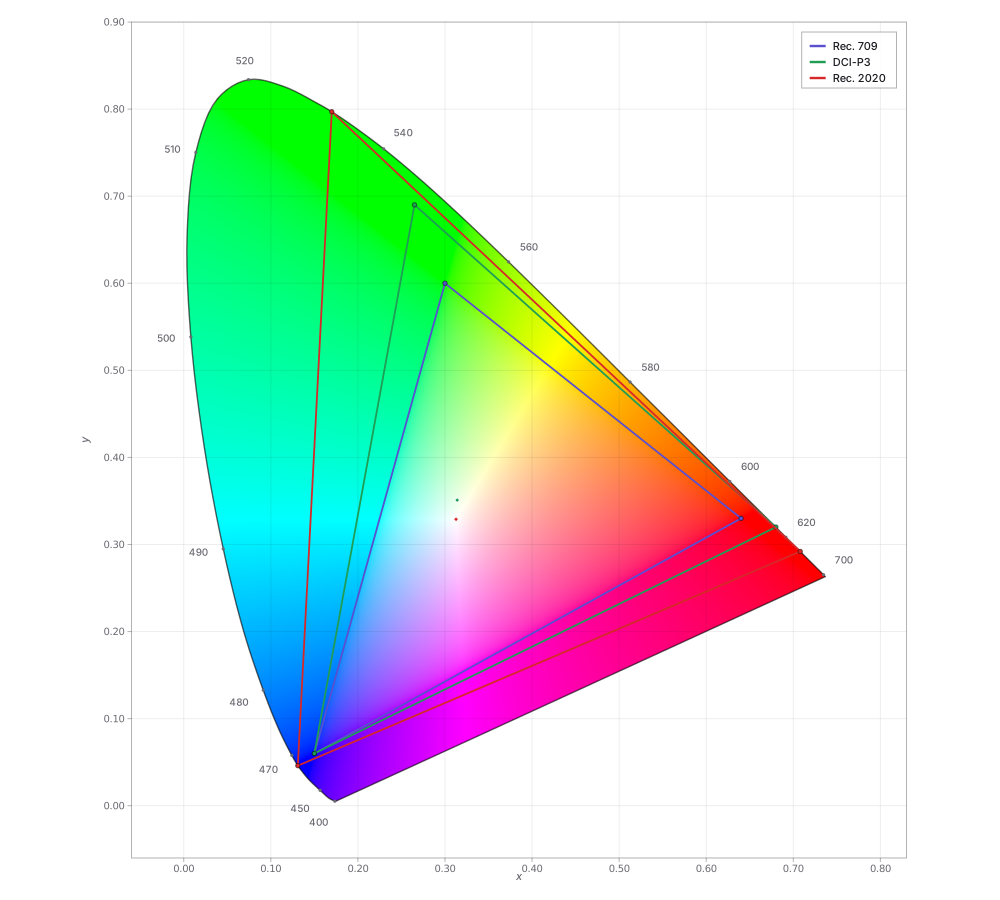
| Rec.709 | The standard HDTV color space and the reference target for home video and broadcast mastering. The same primaries and white point as sRGB. It specifies a camera-side OETF, not a display gamma: the reference display EOTF is BT.1886, approximately 2.4. |
| Rec.2020 | The wide-gamut UHDTV standard and, through BT.2100, the colorimetric container for essentially all current HDR delivery, including HDR10, Dolby Vision, HLG broadcast, UHD Blu-ray, and HDR streaming. No shipping display reproduces the full gamut because its primaries are monochromatic. Content is delivered in the Rec.2020 container but almost always mastered to a P3-D65 volume inside it. |
| DCI-P3 | The standard gamut and white point used in theatrical digital cinema projection: standardized as P3DCI (see below). Substantially wider than Rec.709 (about 36% more area in CIE 1931 xy, mostly in the greens and reds), with an implicit gamma of 2.6 and the DCI white point (0.3140, 0.3510). |
| Display P3 | P3 primaries and a D65 white point with the sRGB transfer function: a registered ICC/CSS encoding and the default display color space on Apple hardware since 2015. Not to be confused with DCI-P3 (gamma 2.6, DCI white) or P3-D65 PQ (HDR mastering). They share primaries and nothing else. |
Three standardized P3 color spaces share one primary set and differ only in white point.2
Their names place P3 before the white-point name with no separator. Use P3D65, not D65P3:
| Color space | White point | Description |
|---|---|---|
| P3D65 | 0.3127, 0.3290 | P3 primaries on a D65 white. Common for HDR home video mastering. |
| P3D60 | 0.32168, 0.33767 | P3 primaries on the ACES white point (ST 2065-1). |
| P3DCI | 0.3140, 0.3510 | P3 primaries on the DCI reference projector white: the "DCI-P3" of the table above. |
Camera Color Spaces
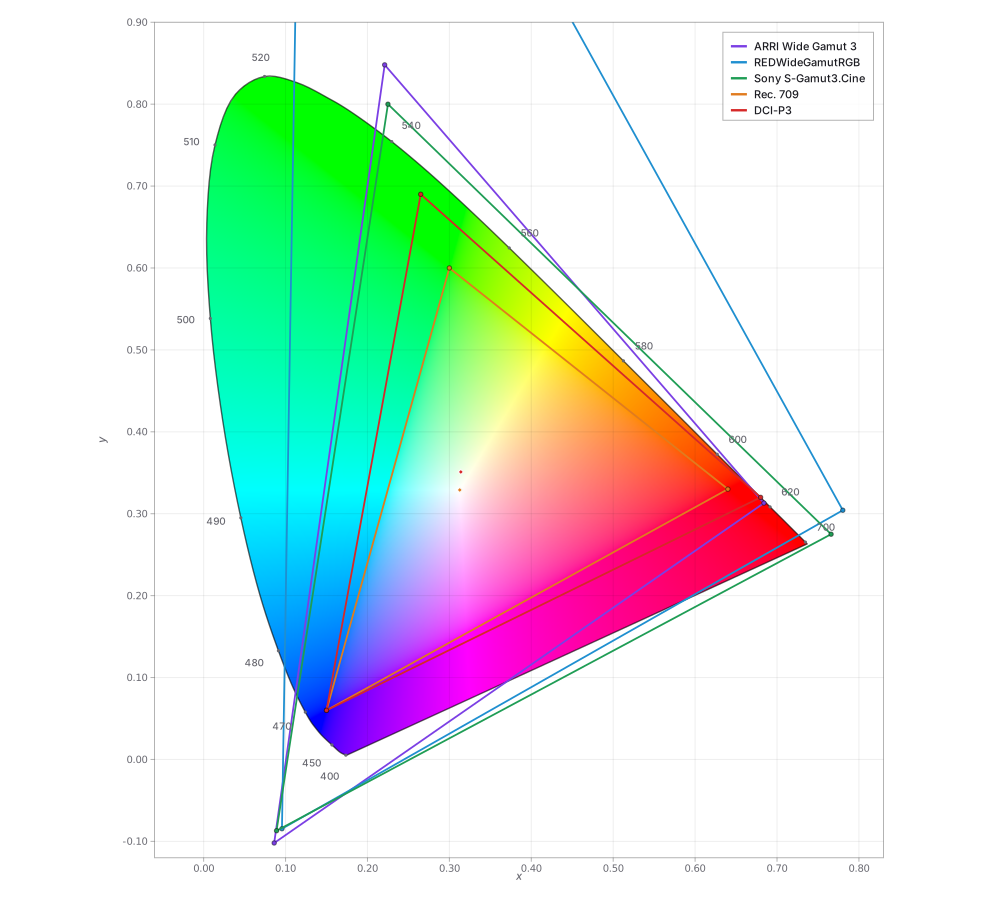
Camera gamuts use virtual primaries that describe an encoding, not the sensor's spectral sensitivity. Some primaries fall outside the visible chromaticity region on a CIE 1931 diagram. Comparing two camera gamuts therefore compares their encoding models, not the colors their sensors can capture.
Why camera manufacturers use different primaries
A camera sensor does not capture directly into a triangle on a chromaticity diagram. Its filtered photosites have overlapping spectral sensitivities. Demosaicing and camera color science convert those measurements into RGB image values.
For mosaic Camera RAW, the named gamut usually describes the RGB decode target. The sensor data itself does not store three complete RGB values at each photosite. A log raster recording has already been demosaiced and encoded into the selected camera gamut. The distinction changes where the camera transform happens, but not the need to identify the resulting gamut correctly.
No practical three-channel cinema camera matches human color vision under every spectrum. A matrix that works well under daylight may produce a different error under tungsten, LEDs, or saturated narrow-band light. The manufacturer characterizes its sensor, chooses the compromise, and then selects an RGB encoding large enough to hold the resulting values.3
The primary set must balance several goals:
- contain the camera's processed RGB values without clipping useful color
- avoid a needlessly large space that creates more virtual colors
- behave predictably in grading, VFX, and display transforms
- support multiple cameras or preserve compatibility with an existing pipeline
Different manufacturers make different choices because their sensors, filters, processing, and pipeline priorities differ. Even one manufacturer may provide two options. S-Gamut3 is the wider, near-camera encoding for ACES and archiving, while S-Gamut3.Cine is a smaller, grading-oriented gamut slightly wider than P3. REDWideGamutRGB instead provides one standardized space intended to contain colors generated by current and past RED cameras. ARRI Wide Gamut 4 was optimized for the ALEV4 sensor while avoiding an unnecessarily extreme gamut.4
Treat the camera gamut as part of the camera encoding. It is not a claim about the limits of the sensor. Assign the exact gamut and log curve before converting the material into the project's working space.
| Color space | Description |
|---|---|
| ARRI Wide Gamut 3 (AWG3) | Legacy ARRI acquisition gamut through ALEXA Mini LF, paired with LogC3. Retained here for correctly interpreting existing media. |
| ARRI Wide Gamut 4 (AWG4) | The wider acquisition gamut introduced with the ALEXA 35 under REVEAL color science, paired with LogC4. Also used by ALEXA 35 Xtreme and ALEXA 265. |
| REDWideGamutRGB | A camera color space designed to contain all colors a RED camera can capture without clipping. It has replaced the earlier DRAGONcolor / DRAGONcolor2 encodings. |
| Sony S-Gamut3.Cine | The practical de facto working space for Sony professional cinema cameras: a slightly smaller, more grading-friendly variant of the fuller S-Gamut3. |
Transfer Functions
Transfer functions define the relationship between RGB tonal values and their equivalents either in the "scene" if scene-referred, or on a display if display-referred. Transfer functions are often called color encodings, encoding spaces, and gamma spaces.
Camera Transfer Functions
| Transfer function | Description |
|---|---|
| Cineon | The standard log encoding of film scans. |
| ARRI LogC3 | Legacy exposure-index-dependent log encoding used by ARRIRAW and ProRes through ALEXA Mini LF. Retained here for existing media. |
| ARRI LogC4 | The EI-independent successor introduced with the ALEXA 35. Different mid-gray placement (0.2784 vs LogC3's ~0.391), and ARRI specifies 12-bit as the minimum quantization: never 10-bit. Always state the version number. |
| REDlogFilm | RED's Cineon-style log curve from the legacy (pre-IPP2) pipeline. RED positions it as a Cineon-style curve rather than an exact Cineon match. In IPP2 it survives only as a selectable output gamma, not as the acquisition encoding. |
| RED Log3G10 | An alternate log curve optimized for HDR grading applications. (Also see Log3G12.) |
| Sony S-Log3 | The current logarithmic encoding used by Sony professional cinema cameras. |
LogC4 is not a drop-in replacement for LogC3
LogC3 was designed around earlier ALEXA sensors and a 10-bit, Cineon-like workflow. S-Log3 was also designed for compatibility with established Cineon practice. DaVinci Intermediate and ACEScct are not camera encodings, but they retain a familiar log grading relationship.5
LogC4 serves a different sensor generation. It carries the ALEV4 sensor's greater dynamic range in a 12-bit encoding and places 18% gray at 0.2784, compared with about 0.391 in LogC3 at EI 800. The lower placement reserves more of the normalized signal range for highlights. The same control move or LUT therefore produces a different result. A LogC3 LUT is not valid for LogC4.6
ARRI supports grading directly in LogC4/AWG4. The workflow recommended here uses it only as a capture and input encoding. Ask the colorist to transform each camera source into one documented timeline working space. ACEScct, DaVinci Wide Gamut / Intermediate, and FilmLight E-Gamut / T-Log are common choices. Test the chosen space with the show look before production.
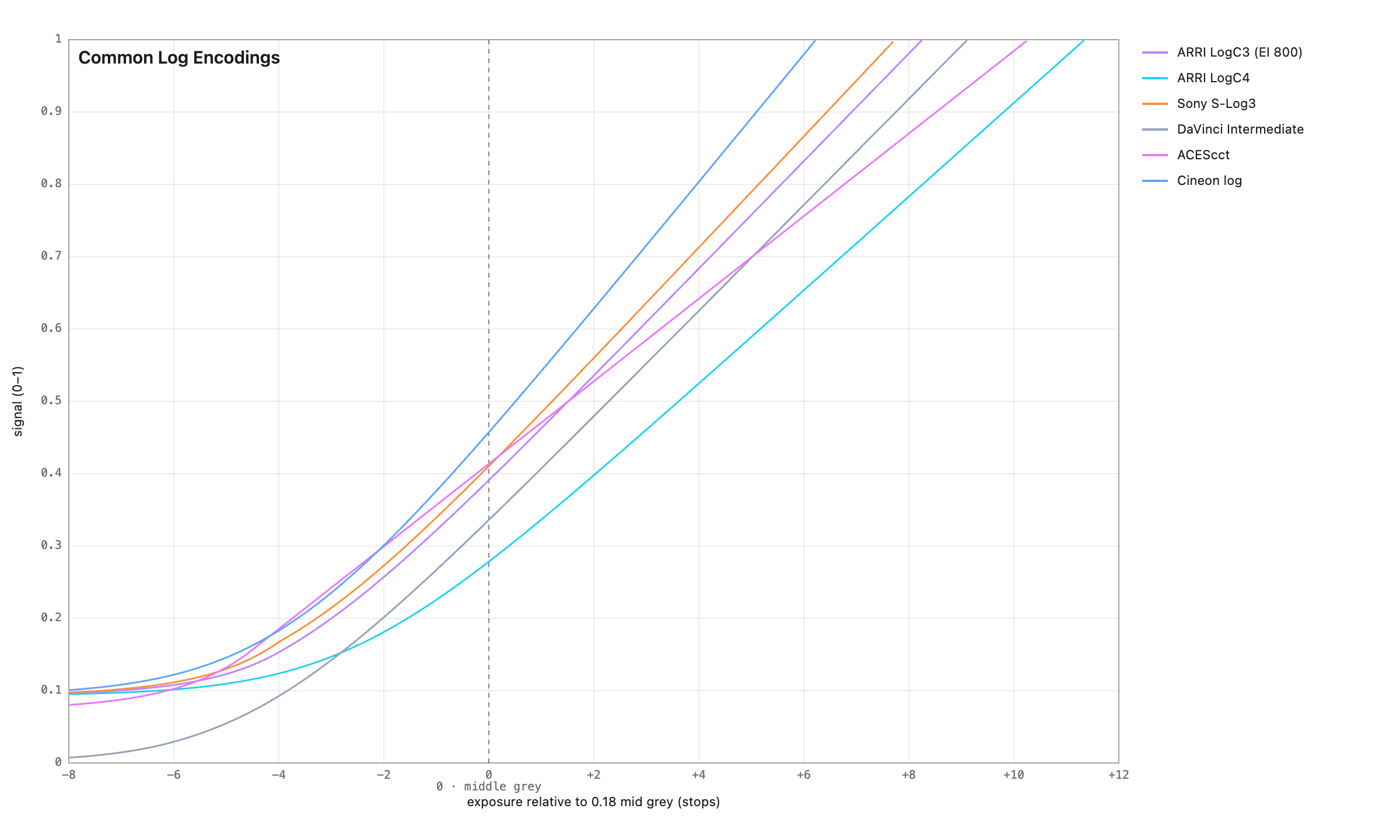
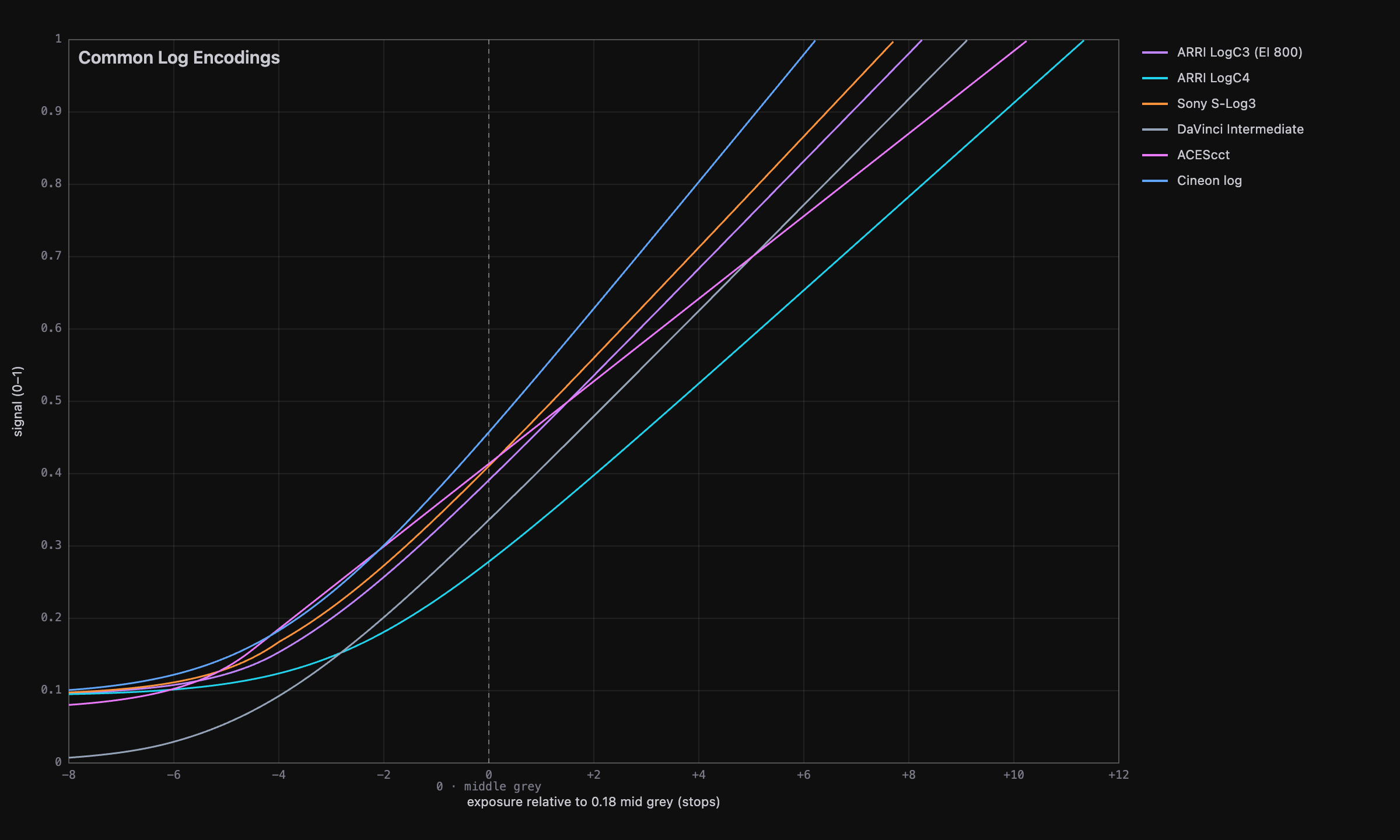
When a project mixes LogC3 and LogC4, assign the correct input encoding to every clip. Do not apply one camera LUT to both. Normalize both sources into the approved working space before matching or grading.7
SDR Display Transfer Functions (EOTFs)
An SDR display transfer function maps encoded signal values to display light. The target changes image contrast, so name it with the color space and viewing environment.
| Transfer function | Use |
|---|---|
| sRGB | Computer and web display. It uses a linear segment near black and a 2.4-power segment above it. Do not describe it as a pure Gamma 2.2 curve. |
| Gamma 2.2 | A pure power function used by some computer-display and legacy video workflows. It is also used as a rough sRGB approximation. |
| BT.1886 / Gamma 2.4 | Rec.709 mastering in a dim surround. This is the normal SDR target for broadcast and streaming masters. |
| Gamma 2.6 | Digital cinema projection in a dark theater. |
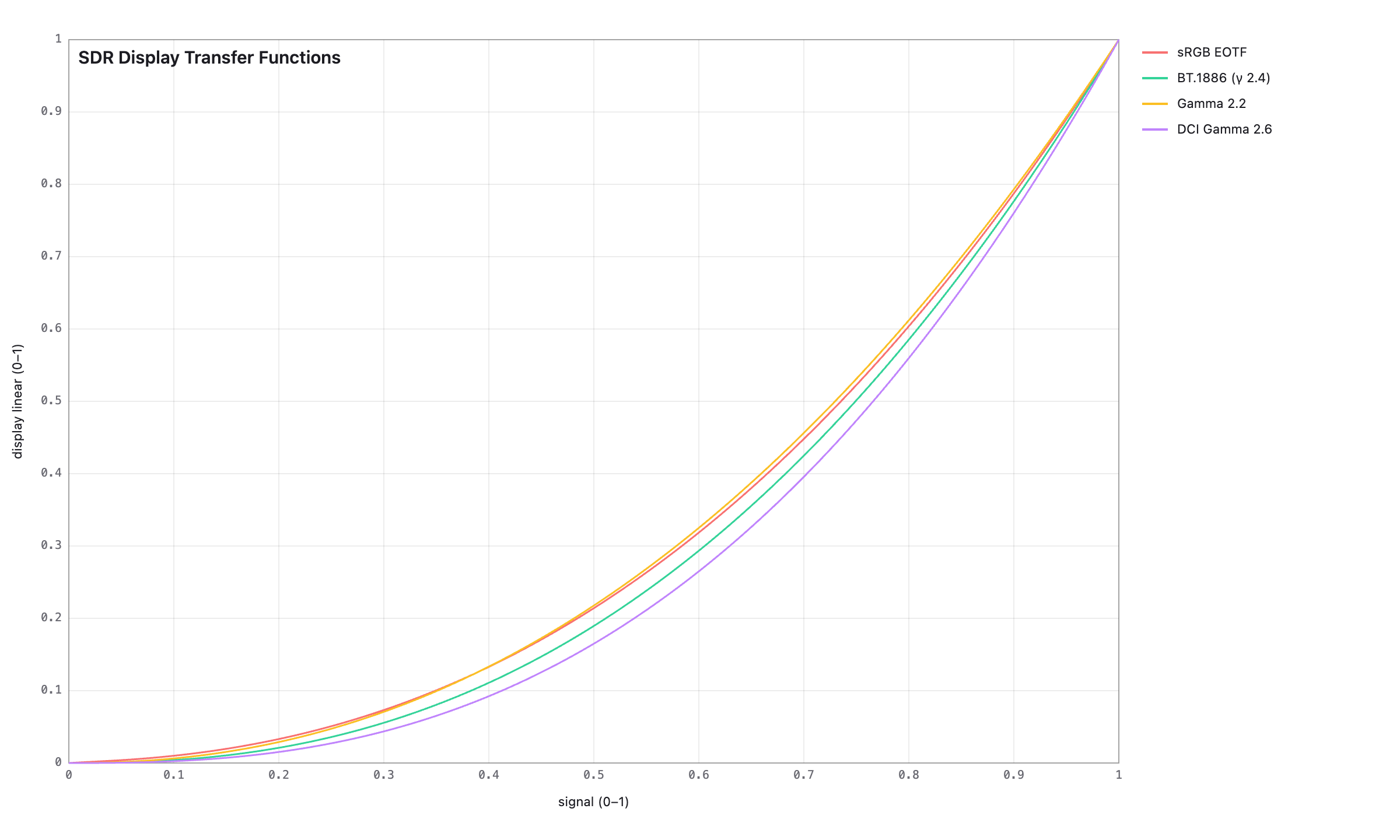
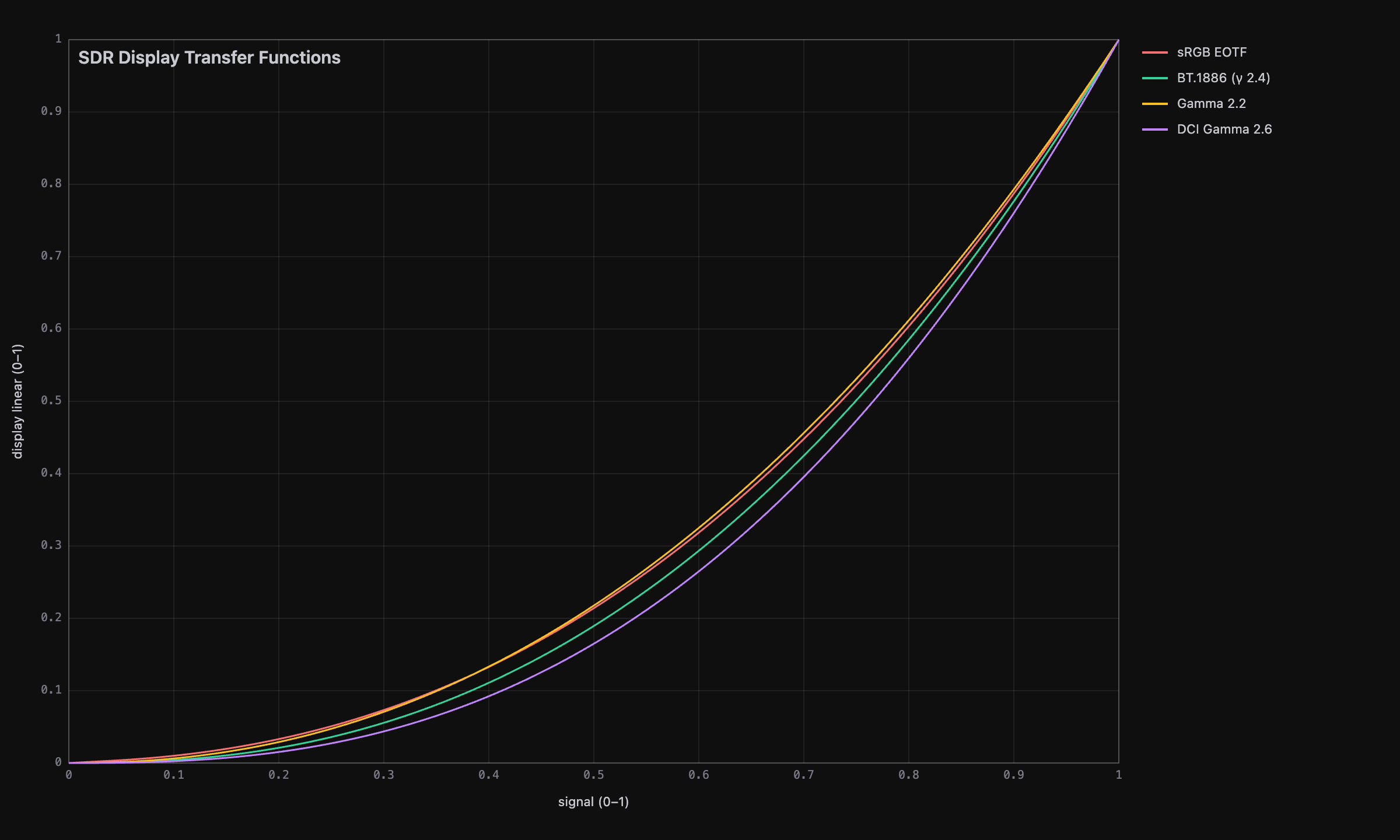
Changing the transfer function after mastering changes the image. Pair the target with its color space in documentation, for example Rec.709 / BT.1886 or P3 / Gamma 2.6.
HDR Display Transfer Functions (EOTFs)
ITU-R BT.2100 defines two HDR systems: PQ and HLG. They are not interchangeable.8
| PQ (SMPTE ST 2084) | HLG | |
|---|---|---|
| Mapping | Absolute. A code value represents a defined display luminance up to 10,000 cd/m². | Relative. Display luminance depends on the display peak and system gamma. |
| Typical use | Feature and episodic mastering, HDR10, HDR10+, Dolby Vision, and streaming delivery | Live broadcast, sports, and HDR/SDR simulcast production |
| Metadata | PQ defines the luminance mapping. Delivery formats may add static or dynamic metadata for tone mapping. | Basic HLG playback does not require mastering-display metadata. |
| Production | Grade and QC on a calibrated HDR reference display at the specified peak. | Follow the broadcaster's HLG monitoring, reference-white, and SDR conversion specification. |
PQ is the established Hollywood and streaming mastering path. HDR10, HDR10+, and Dolby Vision use PQ. Netflix requires P3-D65 / PQ for HDR originals. Treat PQ as the default for a feature or episodic master unless the buyer requires HLG.
HLG is common in live broadcast and sports. Its relative signal and metadata-free operation suit live production and HDR/SDR simulcast. Some broadcasters produce in HLG, then convert the consumer HDR output to PQ.9
Follow the buyer's HDR system
Do not choose between PQ and HLG as a creative preference. The DI implements the buyer's delivery specification. The producer budgets the required HDR monitoring, trim, and QC. See HDR Mastering.
Linear Transfer Functions
| Transfer function | Description |
|---|---|
| Scene-Linear | Gamma 1.0 with middle gray encoded at 0.18. Floating point values exceed 1.0. |
| Normalized Linear | Gamma 1.0 with arbitrary mapping of signal bounded between 0.0 and 1.0. |
DCI-X'Y'Z'
DCI-X'Y'Z' is a display-referred encoding of CIE XYZ tristimulus values. Its transfer function and code-value mapping are defined at 12 bits, but those values are often stored in wider containers, including 16-bit TIFF. It is device-independent, not a conventional RGB color space. Each pixel contains encoded X′, Y′, and Z′ components. Their meaning comes from the underlying linear X, Y, and Z values:
| Component | Role |
|---|---|
| X | Color-matching component used with Y and Z to calculate x |
| Y | Photometric luminance and the component used to calculate y |
| Z | Color-matching component that completes the tristimulus triplet |
X, Y, and Z are not red, green, and blue display channels. Together they define luminance and chromaticity. Chromaticity removes the overall intensity:
x = X / (X + Y + Z)y = Y / (X + Y + Z)
When X, Y, and Z are equal, both x and y are 1/3, approximately 0.333, 0.333. This is the equal-energy neutral of XYZ. It is not the DCI projector white of 0.314, 0.351 or the D65 white of 0.3127, 0.3290. XYZ can represent all of them because it is not bounded by an RGB primary triangle.
Different white points require different X, Y, and Z component levels. At a reference luminance of 48 cd/m², D65 requires approximately X = 45.6, Y = 48.0, Z = 52.3. Normalizing every component to 48 cd/m² would clip Z. The DCI transfer function therefore uses 52.37 cd/m² as the full-scale value for all three components. The difference is component headroom, not a brighter reference white. At the DCI projector white, Y' reaches code value 3960, leaving 135 code values before the 12-bit maximum.10
The linear X, Y, and Z values pass through a 1/2.6 encoding curve and are quantized to 12 bits. The primes in X'Y'Z' identify those encoded values.
Keep DCI-X'Y'Z' at the delivery boundary
Use it only as a display-referred digital-cinema delivery format, not as a working space. Conventional SDR DCDMs and DCPs use this encoding.
See Digital Cinema Mastering for the distinction between 12-bit cinema values and 16-bit TIFF storage.
-
SMPTE ST 2065-1, §§4.2.3-4.2.6, pp. 7-8, and §4.3.2.2, p. 9. ARRI, “Color FAQ,” named section “Does a camera have its own gamut?” ↩
-
Society of Motion Picture and Television Engineers, SMPTE ST 2113:2018: Colorimetry of P3 Color Spaces, table 1 and §§6.1–6.4. ↩
-
ARRI, “Color FAQ,” named section “Does a camera have its own gamut?” ↩
-
ARRI, ARRI LogC4, pp. 6–7; RED Digital Cinema, White Paper on REDWideGamutRGB and Log3G10, p. 1; Sony, Technical Summary for S-Gamut3.Cine/S-Log3 and S-Gamut3/S-Log3, pp. 2–3; Blackmagic Design, Blackmagic Generation 5 Color Science, pp. 1–3, included in the Documents folder of the Blackmagic RAW SDK. ↩
-
ARRI, ALEXA Log C Curve, pp. 6–8; Sony, Technical Summary for S-Gamut3.Cine/S-Log3 and S-Gamut3/S-Log3, pp. 2–3 and 6–7; Blackmagic Design, DaVinci Resolve 17: Wide Gamut Intermediate, pp. 4–5; Academy Software Foundation, “ACEScct Specification,” named section “Encoding Function”; Patterson, Understanding Cineon, pp. 2–3 (archived PDF). ↩
-
ARRI, ARRI LogC4, pp. 4–8, and “Log C,” named section “What is the difference between LogC3 and LogC4?” ↩
-
ARRI, Color Workflows for Mixing ARRI LogC3 and LogC4 Footage, pp. 9–15. ↩
-
International Telecommunication Union, Recommendation ITU-R BT.2100-3, tables 4–5 and annex 1; Netflix, “Dolby Vision HDR Mastering Guidelines,” named sections “What is needed” and “What to deliver.” ↩
-
International Telecommunication Union, Report ITU-R BT.2556-0, annex 8, pp. 54–57; BBC Research & Development, Hybrid Log-Gamma and Displayed Light, pp. 1–2. ↩
-
SMPTE ST 428-1 §§4.1–4.3 and annex B.1. See also SMPTE ST 431-1, table 5.2. ↩