Distribution Deliverables for Independent Film
A distributor's delivery schedule lists the picture masters, audio stems, caption files, artwork, and legal documents required to complete the sale.
Exact requirements usually arrive with the distribution agreement. They vary by buyer, change over time, and can be negotiable. Producing a comprehensive set of deliverables before receiving the delivery schedule risks paying for redundant work.
The producer or post supervisor is responsible for the delivery schedule and assigns each item to the responsible department. The DI, sound, accessibility, artwork, legal, and mastering vendors produce and verify their assigned materials.
Preserve source elements before producing buyer-specific files
Produce a high-quality mezzanine render, if not the recommended preservation masters, along with full-shot textless elements and complete audio stems during principal post-production, while the mix and finishing teams and source projects are active. Wait for the buyer's specification before making format-specific deliverables.
What to produce before / after a sale is made
Complete in principal post-production:
- A pre-sale picture master, retained as a high-quality mezzanine.
- The three preservation masters, where funded: ungraded scene-referred, graded scene-referred, and display-referred.
- Full-shot textless elements for localizable text.
- The mixes needed for planned screenings and home review, discrete stems, the agreed M&E and optionals, and the consolidated mix session.
- The conform project and a verified archive of the film's source elements.
Produce after receiving the buyer's schedule:
- Recipient-specific codecs, rasters, frame rates, and packages.
- Any additional mix versions or loudness adjustments the buyer requires.
- Caption and subtitle formats, and localized language versions.
- Required head and tail builds, slates, and distributor bumpers.
- Platform-specific encodes and delivery QC reports.
Complete the reusable source elements during the scheduled mix, color, and conform. Rebuilding them later can require reopened facilities, rehired vendors, and restored projects. Once a sale defines the remaining requirements, the delivery team can make buyer-specific files from those retained elements. A near-field mix is needed before sale if the film already needs home review or a streaming release; it is not something to postpone automatically.
The no-distributor finish
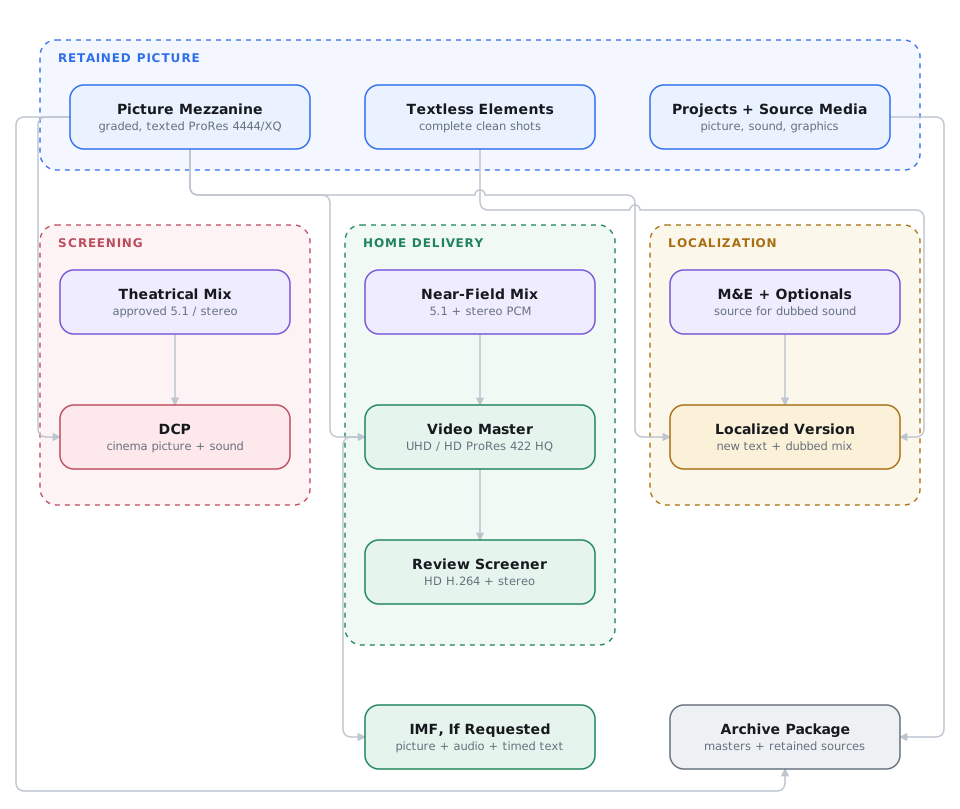
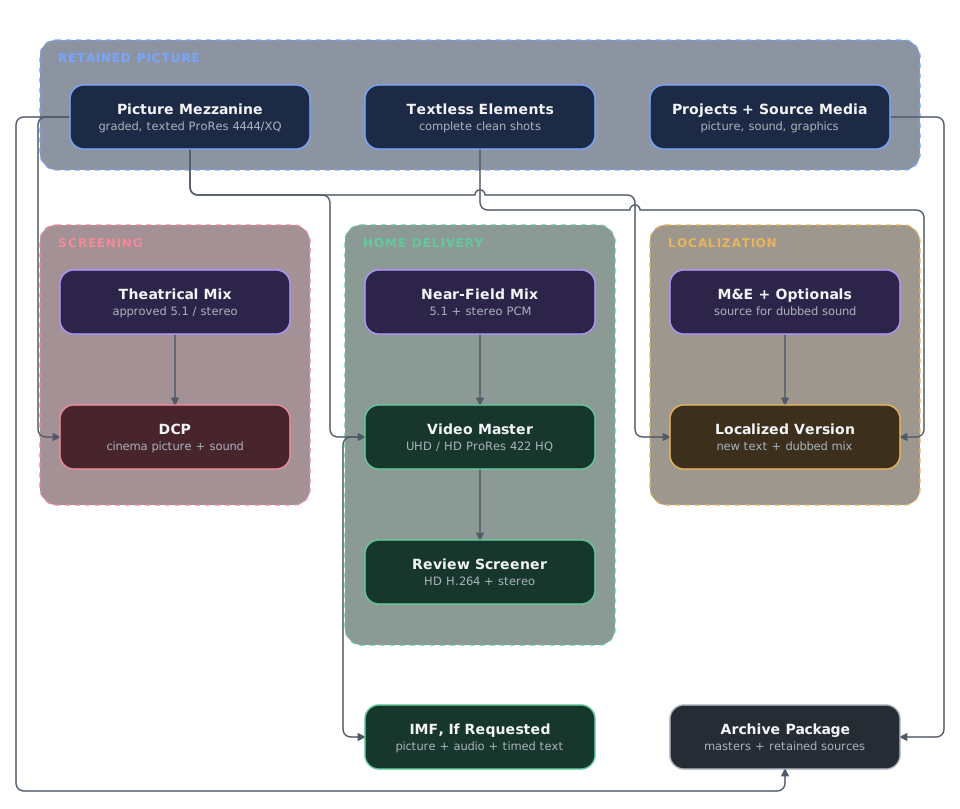
Before a sale, make a simple deliverables package that can support submissions, screenings, marketing, and later delivery:
| Deliverable | Minimum specification | Primary use |
|---|---|---|
| Picture master | UHD ProRes 4444 or 4444 XQ, texted, Rec.709 SDR, native frame rate, intended aspect ratio, and stereo mix | Source master for downstream deliverables |
| Textless elements | Full shots at master quality, supplied as frame ranges, separate QuickTimes, or at the tail of the picture master | International localization and marketing |
| Review screener | HD H.264 QuickTime Rec.709 with stereo audio, password-protected link | Festival submissions, press screeners, buyer review |
| DCP, when a screening requires it | Current approved picture and theatrical sound | Festivals and private screenings |
| Archive package | Funded preservation masters, retained originals and projects, audio masters, manifests, checksums, and restore instructions | Restoration and future deliverables |
Wait for a buyer's schedule before making buyer-specific encodes, captions, language versions, slates, or platform packages.
Festival submission and public exhibition have different music-clearance requirements. See The legal and metadata package.
See Post-Production Planning for the budget and staffing decisions behind this package.
What a mezzanine is
A mezzanine file is a high-quality intermediate used to make downstream deliverables. It sits between the finishing source and the files made for distribution, exhibition, or streaming. It allows a media-services company, another post house, or even a capable editor or post supervisor to produce some deliverables when the budget cannot support returning to the original DI facility. That still requires correct color handling, audio mapping, and QC.
A mezzanine file is not a specific file format. It can use ProRes, DNx, JPEG 2000 in IMF, or another high-quality encoding that preserves picture essence without detrimental compression. For the pre-sale package described here, the mezzanine is a display-referred, graded master, typically containing all texted elements. It can also serve as the graded video master in the archive. It does not replace the other preservation masters or the original media and projects.
Default to ProRes before a buyer supplies a specification
Independent distributors usually ask for a self-contained ProRes QuickTime (.mov), not an
IMF package. ProRes is a common picture master for VOD, TVOD, and home-video distribution.
The distributor makes its own platform-specific encodes downstream. IMF is a studio-and-streamer
interchange format. Produce it only when a studio, major streamer, broadcaster, or large catalog
aggregator specifically asks for it.
Make the pre-sale picture master in ProRes 4444 or ProRes 4444 XQ
It retains 4:4:4 image data and can produce ProRes 4444 or 4:2:2 submasters without returning to the DI. A buyer may request ProRes 422 HQ. Generate that file from the retained 4444 or 4444 XQ master. See Common Working Formats.
The picture master baseline
Prepare the following source elements before the buyer supplies a specification:
- Raster and rate. Use the film's finished raster and native frame rate, usually 23.976 fps. A UHD master is 3840×2160. An HD master is 1920×1080. Deliver the intended, creative aspect ratio inside the full delivery raster, with the intended mattes or blanking applied.
- Color. Resolution and dynamic range are separate decisions: do not assume 4K means HDR. A 4K SDR master is ordinary and is still Rec.709. Many indie 4K deliverables are SDR. An HDR delivery master commonly uses a BT.2020 container, often with colors limited to P3, and the PQ / ST 2084 EOTF, at 10- to 12-bit. Where HDR is required, expect to produce HDR10, Dolby Vision, or both. The buyer decides, so read the schedule rather than assuming. See HDR Mastering.
- Heads and tails. Some distributors specify a strict head build: slates, bars and tone, and black, each with exact timing. Others require the first frame of picture to start the file. Build that into the deliverables after a buyer defines the requirements, not before.
How common is HDR for a low-budget film?
A September 2026 check of 12 films budgeted below US$5 million, commercially released in the US during the preceding five years, verified an HDR streaming or UHD Blu-ray edition for 4 of 12 (33%): Terrifier 2, Terrifier 3, Talk to Me, and Presence.12 This is a minimum confirmed share of a small convenience sample, not an industry-wide estimate. The other eight had no verified HDR edition in the sources checked; that does not prove none exists. The sample includes all five 2024 John Cassavetes Award nominees and seven reported-budget examples, so it overrepresents award-selected films and commercially visible horror.
In a separate check of 13 streaming and TVOD outlets, ten documented HDR film or television offerings. Tubi also documented HDR-related playback for a special live event, but that is not evidence of an HDR movie catalog. Shudder documents mostly 1080p content, and MUBI documents HD and 4K without establishing HDR availability in the guidance checked.13 The online title-by-title audit and outlet list identify the sources, territories, and uncertainties. A service offering HDR does not mean every acquired film needs it.
Budget HDR for a reason
The producer and colorist should decide whether HDR serves the film's creative intent or a known delivery requirement. Price it before committing, and negotiate who pays if a buyer requests it later. Release listings do not reveal whether HDR was commissioned before or after the sale, and this sample cannot establish a financial return on that work.
Audio mixes and targets
Theatrical and home entertainment use different monitoring levels, dynamic ranges, and delivery requirements. Build the required mixes and stems while the session and source material remain open.
Budget sound for the planned exhibition
If theatrical and home release are planned, the producer should include both mixes and the agreed stems in the sound bid. A streaming-only production needs a properly finished near-field mix, not an unnecessary theatrical version.
Build stems during the mix
Produce linear PCM at 48 kHz/24-bit, a 5.1 mix, a true stereo or Lt/Rt fold-down, and discrete dialogue, music, and effects stems. Plan a fully-filled M&E for scripted work unless the buyer specifies otherwise. Merely summing the music and effects stems can leave holes: footsteps, clothing movement, room tone, and other production sounds may exist only in the dialogue tracks. A fully-filled M&E replaces those missing sounds so a dubbed version retains the original non-dialogue soundtrack. It can require additional Foley recording, effects editing, mixing, and QC, not just another export. Agree on that labor and cost before the mix.22
Some unscripted and nonfiction specifications accept a partially-filled or augmented M&E. The required depth depends on the program and buyer. Obtain that requirement before bidding the work.
Separate language-bearing optionals
Keep territory-specific material on labeled optional tracks when it should not be part of the universal M&E. Optionals can include discernible walla, foreign dialogue, actor efforts, song vocals, broadcasts, public-address announcements, or censorship effects. Follow the buyer's specification.22
The mixer should print the agreed elements while the session is open. Printing existing stems then avoids a later recall. Creating missing M&E content is separate work and may be substantial.
Theatrical vs. near-field: two mixes, two targets
A cinema mix and a home/streaming mix are separate deliverables:
- A theatrical mix is monitored on a calibrated dubbing stage at reference level, commonly 85 dB SPL per screen channel using the specified −20 dBFS calibration noise and cinema room response.14 It is mixed by ear with wide dynamic range and is not loudness-normalized to a number. This is what feeds a DCP.
- A near-field mix is made for home entertainment. Speakers are closer to the mixer in a smaller room, rather than behind a distant cinema screen. A calibrated 79 or 82 dB SPL reference is a practical example, chosen for the room and delivery workflow, not a universal setting.15 The mixer adjusts the dynamic range for home playback and follows the distributor's integrated-loudness target, measured in LKFS or LUFS. Those are equivalent loudness units when the measurement method is the same; they are not the room's SPL.16
Deliver the mix made for the destination
Do not deliver the theatrical printmaster to a streamer. Derive a near-field pass with the required dynamic range and loudness target. Do not assume a near-field mix will play correctly in a calibrated theater either: its denser, higher average level may make it too loud.
Loudness targets by destination
Loudness figures are meaningful only with their measurement method, gating, tolerance, and true-peak limit. Compare the complete requirement, not the target number alone. Targets vary by distributor.
Dialogue-gated measurement evaluates the mix during passages identified as containing dialogue. It does not mean measuring the isolated dialogue stem. Program-gated measurement evaluates the whole program but excludes passages below specified level thresholds; it does not detect speech. Music and effects can therefore change a program-gated reading substantially without changing a dialogue-gated reading in the same way.16 This handbook uses dialogue; dialog is an alternative spelling found in meter interfaces and some specifications.
| Destination | Integrated loudness | Max true peak |
|---|---|---|
| Theatrical / DCP | Not normalized to an integrated-loudness number | Preserve appropriate headroom; follow theatrical QC |
| Netflix branded delivery15 | −27 LKFS ±2 LU, dialogue-gated | −2 dBTP |
| Prime Video acquired long-form18 | Confirm the current partner requirement; see below | Confirm with the partner contact |
| US digital television1 | −24 LKFS target; follow the broadcaster's dialogue-anchored long-form measurement and tolerance | Follow the broadcaster's ceiling |
| EBU R128 broadcast delivery17 | −23 LUFS, program-gated; ±0.2 LU measurement tolerance for normal prerecorded delivery | −1 dBTP for linear PCM production audio |
These numbers are not directly comparable
Match the target, gating method, meter mode, and peak ceiling. Do not substitute a program-gated reading for a dialogue-gated requirement simply because both are expressed in LKFS.
ATSC A/85 is a recommended practice from the Advanced Television Systems Committee for digital television audio loudness. It is not the name of a streaming service or a universal streaming delivery specification.1
Confirm Prime Video's current long-form audio requirements. Its public Video Requirements page does not specify a loudness target, but its June 2026 partner update announced requests for written loudness-compliance certification from July 1. That notice names ATSC A/85 without resolving every delivery parameter. Obtain the applicable target, gating, tolerance, and peak ceiling from the partner contact. Advertising specifications and third-party summaries alone do not establish the acquired feature's requirement.18
Consult the mixer and explain the intended and likely distributors. Without a buyer specification, ask for roughly −24 LKFS full-program with a −2 dBTP ceiling as a provisional home-review/delivery baseline, not a promise of acceptance everywhere.
Relay the buyer's audio requirements early
The producer or post supervisor should send the mixer the target and gating method as soon as the buyer supplies them, not just when it is time to export deliverables. The mixer should follow that specification and include compliance checking in the delivery work.
Keep the printmaster, stems, and mix session archived and accessible. A changed loudness target can require a new stage pass and QC cycle.
What to ask your mixer to bid
A bid for “the mix” does not establish which versions, stems, M&E elements, loudness targets, or revisions are included. Define the complete package before comparing prices.
Bid the complete sound package
At bid time, the producer and mixer should agree on the planned destinations and include:
- If theatrical is possible, bid a theatrical mix and a near-field mix. Mix theatrical first when an appropriate dubbing stage is available, then derive near-field sound. See the small-room alternative below.
- Bid the full stem and M&E package: 5.1 and stereo, discrete DME stems, the required depth of M&E, applicable optionals, and a dialogue guide. Produce these while the mix session is open.
- A near-field mix to the agreed specification, not simply a stereo bounce.
- Consolidated Pro Tools session files, all required audio, session settings, and a list of plug-ins and versions. Include printed processing or stems where a dependency may not be available later, and test that the archive opens with the supplied media.
- Delivery exports and QC. For a streaming-only film, near-field is the primary mix. These finishing checks belong in that bid; they are not automatically another paid “mastering pass.”
When the mixer works in a small room
For a theatrical-led release, the ideal sequence is to establish the theatrical mix on a calibrated dubbing stage, then adapt it for home playback. If that is unaffordable, the mixer can do the main editing and mixing in a calibrated small room, retaining a flexible session and separate stems. The producer can then rent a suitable theatrical mixing room for focused review and adjustment.
Budget the mixer's attendance, session transfer, room setup, changes, and a final playback check. An ordinary rented cinema can reveal problems, but it is not necessarily equipped to revise the mix. Verify facilities before booking. The theatrical adaptation may need changes to dialogue, effects, bass, and dynamics; turning down the near-field master is not a reliable substitute. An upmix normally means creating more playback channels, such as stereo to 5.1. Adapting a 5.1 near-field mix to 5.1 theatrical is a room and balance change, not a channel upmix.
Dolby Atmos and IAB
Dolby Atmos is not a universal independent-film delivery requirement. It can become a contractual requirement on a commissioned title or premium release, so the producer should ask before the sound bid. For a pre-sale film without such a requirement, prioritize a strong 5.1 and stereo package. Price an immersive mix separately if the creative plan or likely buyer justifies it.
Atmos describes an immersive sound workflow and presentation, not one interchangeable file. IAB (Immersive Audio Bitstream) carries immersive audio in digital-cinema and certain IMF deliveries. A home Atmos master commonly uses an ADM BWF deliverable instead. The sound facility must supply the form the recipient requests; a home Atmos file is not a ready-made cinema IAB track.19 Retain the required conventional mixes as well. See DCP sound and IMF.
Picture text and localized versions
Localization may replace titles, subtitles, signs, screens, or other photographed and designed text. Clean source material lets a distributor build those versions without reconstructing the finished image.
Render textless material as complete shots
During the DI, render the complete logical shot for every shot carrying localizable text. Do not render only the frames where the text appears. Supply the material as numbered frame ranges, separate full-quality QuickTimes, or a textless section at the tail of the video master. Follow the buyer's order, timing, and audio layout. Distribution inserts normally cover the complete shot as it appears in the cut, not extra VFX handle frames.20
Use these terms to identify what the picture contains:
| Term | Meaning |
|---|---|
| Original or texted version | Approved picture with its intended creative titles, credits, and on-screen text |
| Non-subtitled version | Burned-in dialogue subtitles are absent; this alone says nothing about removing titles, locator cards, or credits |
| Textless insert | A complete clean replacement shot, not only the frames carrying text |
| Textless bed | The collection of textless inserts required to rebuild localized graphics |
| Fully textless master | A complete program with the clean shots inserted |
| Semi-textless master | A complete program with the agreed localizable text removed and other text retained; the buyer defines the exceptions |
| Localized version | Picture, audio, or timed text adapted for a language or territory |
| Forced narrative | Timed text translating only required dialogue or on-screen information, such as English subtitles for Spanish dialogue in an otherwise English-language version |
| Supplemental package | New or replacement resources that rely on assets in an earlier package |
A non-subtitled master and a semi-textless master are therefore not necessarily the same file. Removing dialogue subtitles can leave localizable text such as “Madrid, three years earlier” or an English-language end card. Locator cards, main titles, and credits need clean replacements when the buyer intends to translate or replace them. For text over picture, retain the full clean shot; for a standalone card, retain its clean background and editable graphics. Keep title and credit projects, fonts, and any required licenses. Do not remove photographed text or every credit automatically: agree on the scope of the textless package.20
Retain a clean route to localized versions
Keep the texted master and matching textless inserts. Keep forced narrative subtitles for foreign dialogue or on-screen signage separate so each territory can replace them. Never burn subtitles into the only master.
Text over black
Text over black does not automatically require a separate black slug. A buyer may allow it to remain in a delivery called “textless.” For example, Netflix retains end credits over pure black or white in its textless picture masters and does not require clean inserts for those credits.2 That exception does not automatically cover every title or locator card.
If the buyer requires a card to be removed from a full-length master, the DI replaces its text with the clean background for exactly the same duration. For a plain black card, that means black frames, not closing the gap and changing the film's timing. For a separate insert package, the producer can ask whether identifying that black interval is sufficient instead of delivering a redundant black movie. Retain any picture, texture, or animation behind the text, and keep the editable title project. The delivery specification decides which text stays and which disappears.
Captions and subtitles
SDH means Subtitles for the Deaf and Hard of Hearing. It includes dialogue and relevant speaker identification, music, and sound information, rather than dialogue alone.
Describe each timed-text deliverable by its purpose, presentation, format, and language. These are separate properties:
| Property | Examples |
|---|---|
| Purpose | Translation subtitle, SDH, forced narrative, commentary |
| Presentation | Open or closed |
| Format | IMSC, TTML, SCC, SRT, STL, ITT |
| Language | Recipient-approved language and regional tag |
Caption and localization deliverables can include:
-
IMSC 1.1 / TTML, a structured studio-master format from which other subtitle files can be derived. Do not make it speculatively. Supply it when the buyer requires it.21
-
SDH or closed captions in the buyer's required format. SDH describes the content, including dialogue and relevant non-speech information. Closed describes how the viewer turns it on or off. Do not infer the required file format from the legal obligation alone. Reading speed, line length, duration, and line-count limits also vary. Follow the delivery schedule rather than a generic caption template.
- Subtitles in a format that varies by house, usually
.srt,.stl, or.itt, with foreign-language subs (Latin-American Spanish and French are the most-requested) expanding the sale. - A CCSL (combined continuity and spotting list) and/or dialogue list is a standard legal and localization deliverable. See the DCP chapter for how caption and continuity files also feed accessibility tracks (OCAP/CCAP) on the theatrical side.
- Audio description is a separate audio accessibility asset. Do not classify it as timed text.
Identify every timed-text file
Record its purpose, presentation, format, source frame rate, language, and recipient-required language tag. Structured interchange commonly uses an IETF BCP 47 tag.
Which accessibility requirements apply?
The exhibition destination and territory determine the requirements. A festival acceptance does not establish that the same caption file will pass television or streaming delivery.
- U.S. television: the FCC's captioning rules cover non-exempt television programming, including broadcast, cable, and satellite distribution. They address caption availability and quality, including accuracy, timing, completeness, and placement.4
- Internet delivery: the FCC also covers non-exempt full-length programming distributed online after it has appeared on U.S. television with captions, plus certain online clips. This is not a blanket rule covering every streaming-only film. Other accessibility laws and the platform's delivery contract may still apply.45
- Theatrical exhibition: the FCC does not set cinema caption requirements. In the U.S., the Department of Justice's ADA rules generally require covered digital cinemas to provide closed captions and audio description when the film is distributed with them. That cinema rule is not itself a blanket requirement for every filmmaker to create those assets.6
Festival requirements vary, but festivals are not automatically exempt from accessibility obligations. Some specify exact DCP accessibility tracks, while others arrange access with the filmmaker. The producer asks the festival's technical team which files and screening versions it needs. See DCP accessibility.
For home-entertainment release, requirements can differ by territory as well as platform. A captioning company with experience in those destinations can author, convert, and QC the required files. Budget that expertise when delivering to several territories, preparing unfamiliar broadcast or DCP caption formats, or when nobody on the post team understands the applicable rules. The distributor or legal adviser confirms legal obligations. A captioning vendor implements the technical requirements.
AI captioning
Automatic captioning can create a rough transcript or initial timing pass. It does not produce a delivery master without human review.
AI captions are a draft, not a deliverable
Check automatic output for:
- SDH non-speech information: captions must identify speakers and describe music, sound effects, and off-screen audio where needed to understand the scene. Auto-transcription often misses this.
- Reading speed and formatting: follow the recipient's limits for reading speed, line length, line count, and duration. 32 characters per line is a CEA-608 format limit, not a universal recommendation. Netflix's English timed-text guide, for example, permits 42 characters per line.3
- Timing and sync: timing in quick dialogue scenes often requires human refinement. A reviewer balances readable duration, speaker changes, and the rhythm of the edit rather than accepting every automatically generated boundary.
- Accuracy: names, technical terms, accents, and homophones require manual correction.
A distributor can repair a failed file and charge back the cost, sometimes with a penalty.
Require human caption review
The producer budgets a professional captioning vendor or assigns a member of the post-production team who can conform and QC the captions against the delivery specification. That reviewer must understand the required caption format and style, watch the complete film, and verify the file against the final picture and sound. An automated check alone is not this review.
Quality control
Most distributors require the masters to pass QC at an approved third-party facility before acceptance, usually at the filmmaker's expense.
Budget the required QC cycle
- Confirm whether the distributor requires an approved QC facility.
- Obtain the required QC standard. An international-broadcast or Blu-ray pass may differ from a domestic-release pass.
- Include one correction, re-export, and repeat-QC cycle in the delivery schedule and budget.
The distributor may repair a failed file and charge the cost back to the filmmaker, sometimes with a penalty before paying revenue.
Harding testing and photosensitive imagery
A Harding test uses HardingFPA, a flash-and-pattern analyzer, to check images against guidelines intended to reduce the risk of photosensitive seizures. Photosensitive epilepsy (PSE) testing is the broader process. Other accepted tools can perform it. These tests assess flashing brightness, red flashes, and high-contrast patterns, not general image quality.7
PSE testing is an established part of broadcast delivery, particularly in markets such as the UK, where broadcasters must take precautions against this risk.8 It is not automatically included in every QC quote or required for every streaming or theatrical release. Netflix, for example, requires testing for its branded animated titles and may request it for live action with substantial VFX, action, strobing, or other risk factors. Its requirements should not be generalized to every acquisition or platform.9
The finishing or QC facility can operate the testing software, test the required master, and supply a report. Early checks give the editor, VFX team, and colorist time to adjust a problematic sequence. Changing flash cadence, contrast, affected image area, or patterns may resolve a failure without removing the scene. A later edit or grade can change the result, so an early pass does not replace testing the finished delivery version.9
Confirm PSE testing before final delivery
The producer asks the distributor and QC facility whether testing is required, which test settings and SDR or HDR versions to use, and who submits the report. Flag strobing scenes and graphics early. After a failure, the filmmakers and finishing team agree on corrections, then the facility retests the revised master. Any exception or viewer advisory needs the recipient's agreement. A warning is not an automatic substitute for a required pass.
The legal and metadata package
A full schedule can contain thirty-plus legal and metadata items, including:
- E&O insurance (errors & omissions): effectively universal. Limits commonly cluster around $1M per occurrence / $3M aggregate with a deductible near $25K and a multi-year term, and can run higher at the top end. Obtain the distributor's exact limits and exclusions.
- Chain of title and a current (≤ 30-day) copyright & title report, proof of copyright registration, and often a UCC search confirming no secured creditor interests in the film.
- A music cue sheet and executed music licenses (and composer agreements).
- A CCSL / dialogue list, metadata sheet, billing block, key art (usually layered, with fonts), festival laurels, cast/crew list, and photo IDs & clearances.
- Lab access letter, certificate of origin, talent agreements, and, for some buyers, an ISAN number.
Festival exhibition does not excuse uncleared music. Sundance permits temporary music at submission, but an accepted film must clear or replace it before public exhibition. Tribeca's 2025 rules likewise make selected filmmakers responsible for exhibition and promotional clearances.11
Resolve music clearances before public exhibition
The producer or music supervisor checks the festival's current submission and exhibition rules. Before public exhibition, clear the music for that use or replace it with cleared music.
Schedule the release from the complete delivery list
Aggregators commonly require all approved elements 90–120 days before the street date. The delivery period may not begin until every item is received and passes QC. For a large schedule, budget a post-production supervisor or delivery coordinator.
Lab Access Letters and Asset Authorization
A lab access letter lets an authorized distributor or other named party order copies or releases of a film's materials directly from the facility holding them, within the agreement's terms. The “lab” may be a DI facility holding digital masters, not a photochemical laboratory.10
- For the filmmakers: it provides a practical route for the distributor to obtain the materials it needs. The producer confirms what can be supplied, to whom, and who pays for the work. Because the letter can grant lasting contractual rights, the producer has legal counsel review it before signing.
- For the DI vendor: it confirms which materials the facility holds and whose orders it may fulfill. The vendor agrees to the release conditions and service charges, then checks requests against that authorization.10
A deal-required lab letter is different from the contact list used for routine post-production work. The distributor supplies its required form, and the producer and DI vendor agree on the terms. A general contact list does not replace that agreement.
Control Every Release
Filmmakers should expect their vendors to keep production materials private and secure. Beyond staff access needed to perform the contracted work, only people the producers authorize should receive access or be able to order copies or removal of materials.
Control every release
The producer gives each vendor the names of people authorized to approve access and releases, and updates that list when it changes. The vendor checks requests with an authorized contact before giving anyone else access or sending materials out.
Trailer and marketing deliverables
A trailer is a separate edit, but it still depends on the feature's approved color, framing, VFX, titles, sound, and source assets. Treat marketing handoffs as part of the production pipeline.
Keep the trailer in the feature pipeline
Match the feature's aspect ratio, frame rate, finish, and color pipeline. If another facility handles marketing, supply the same LUTs, transforms, and graded elements. Ask whether the distributor wants a rating card, vertical 9:16 cutdown, platform-specific key art, or H.264 review screener.
Trailer versions
Plan for repeated trailer versions: announcement, dated, in-theaters, TVOD/SVOD, broadcast, social, and an evergreen version with no date.
Preserve the trailer source package
- Deliver the trailer textless, the same way you deliver the feature textless. Reissues use new end cards over the same picture. Do not force them to recut a texted master.
- Archive the graphics package. Retain layered project files, fonts, and key art with licenses that cover later campaign versions. Theatrical artwork may not be cleared for later home-video use.
Trailer-specific VFX
Trailers often contain earlier shot versions and a deliberately stronger grade. Track these as marketing versions rather than treating them as feature-final shots.
Budget trailer-specific VFX
Plan for:
- different frame ranges than the feature version needs
- censored or softened variants for a green-band cut
- alternate or replaced dialogue
- spoiler-free versions that conceal a reveal the feature depends on
Charge this work to the marketing budget and schedule it as overage work.
Reserve schedule capacity for trailer requests and identify which artists can service them without delaying feature finals.
-
Advanced Television Systems Committee, ATSC Recommended Practice A/85:2026-07, §§5.1.1, 5.2, and 6, plus annexes L and M. The legally binding US broadcast rule, 47 CFR §73.8000(a)(4), still incorporates the 2013 edition. ↩↩
-
Netflix, “Textless Elements Creation and Delivery Guidelines,” “End Credits.” Accessed 7 Sept. 2026. ↩
-
Telestream, MacCaption 8.0.2 User Guide, “Compress Text Blocks for Captions,” p. 185, CEA-608 limit. Netflix, “English (USA) Timed Text Style Guide,” secs. I.2 and II.3, “Character Limitation.” ↩
-
Federal Communications Commission, 47 CFR Part 79, Closed Captioning and Video Description of Video Programming, secs. 79.1(b), (j), and 79.4(b), television requirements, quality standards, and Internet-delivery scope. ↩↩
-
U.S. Department of Justice, “Guidance on Web Accessibility and the ADA,” “When the ADA Requires Web Content to Be Accessible” and caption examples. This guidance is not a platform-by-platform legal determination. ↩
-
U.S. Department of Justice, Americans with Disabilities Act Title III Regulations, sec. 36.303(g), particularly (g)(1)–(2), and (h). See also “ADA Requirements: Effective Communication,” covered public entities, businesses, and nonprofits. ↩
-
Cambridge Research Systems and Whitedot Scientific, HardingFPA, product overview and supported guidelines. ↩
-
Ofcom, Broadcasting Code, “Section Two: Harm and Offence,” rule 2.12. The rule concerns broadcaster precautions, not a requirement to use one software brand. ↩
-
Netflix, “Photosensitivity Prevention Guidelines,” “Is My Content Required to Pass a PSE Test?”, “When Should I Test?”, “Who Can Test for Me?”, and “Appendix: Accepted PSE Testing Tools.” Accessed 7 Sept. 2026. ↩↩
-
Public Media Works and Regent Worldwide Sales, “Delivery Schedule and Laboratory Access Letter,” sched. 2(A). See also ESPN Enterprises and Genius Products, “Form of Laboratory Access Letter,” exhibit C, pp. 26–28. ↩↩
-
Sundance Institute, 2027 Sundance Film Festival Submissions FAQ, questions 13–14, p. 6. See also Tribeca Festival, 2025 Festival Entry Rules and Regulations, “If Your Project Is Selected,” p. 10. ↩
-
Film Independent, “2024 Film Independent Spirit Awards Nominees,” “John Cassavetes Award,” for the five-film sub-US$1 million cohort. HDR editions: Umbrella Entertainment, Terrifier 2, Terrifier 3, and Talk to Me, technical specifications; Apple, Presence, US HDR10+ format badge. Full budget evidence and unresolved editions are in the linked audit. ↩
-
See the linked audit for all 13 outlets. Smaller-service evidence: Tubi, “Super Bowl LIX on Tubi,” dynamic-range troubleshooting; Shudder, “What Resolutions Are Titles Available In?”; MUBI, “Are Movies Available to Watch in HD and 4K?” Checked 7 September 2026. These pages do not establish HDR feature-film delivery requirements. ↩
-
SMPTE, RP 200:2012, Relative and Absolute Sound Pressure Levels for Motion-Picture Multichannel Sound Systems, sec. 6; ST 202:2010, Dubbing Theaters, Review Rooms and Indoor Theaters: B-Chain Electroacoustic Response, room-response requirements. ↩
-
Netflix, Post-Production Branded Delivery Specifications, version 5.2, “Sound Mix Specifications & Best Practices,” near-field monitoring and loudness requirements. These are branded-delivery requirements, not a substitute for a particular acquisition agreement. ↩↩
-
ITU, Recommendation ITU-R BS.1770-5, Algorithms to Measure Audio Programme Loudness and True-Peak Audio Level, annex 1, level-gating algorithm; EBU, R 128:2023, p. 3, note 1, LKFS/LUFS equivalence; ATSC, A/85:2026-07, secs. 5.1.1 and 5.2, anchor-element and full-program measurement. ↩↩
-
EBU, R 128:2023, Loudness Normalisation and Permitted Maximum Level of Audio Signals, recommendations h–m, pp. 3–4. The ±1 LU allowance concerns cases where meeting the target is impractical, such as live programming; it is not the normal prerecorded target tolerance. ↩
-
Amazon Prime Video, “Video Requirements,” updated 31 May 2026, embedded audio sections; “Supply Chain Updates: June 2026,” “Audio Loudness Compliance & Upcoming Certification Requests,” updated 25 June 2026. Checked 7 September 2026. The latter announces certification requests, not a new numeric long-form delivery table. ↩↩
-
SMPTE, ST 2098-2:2019, Immersive Audio Bitstream Specification, scope; Netflix, Post-Production Branded Delivery Specifications, Dolby Atmos near-field and ADM BWF delivery requirements, where applicable; “Interoperable Master Format (IMF): Overview,” immersive-audio packaging. ↩
-
Walt Disney Studios, “Program Editorial Information,” “Mastering Master Types.” ↩↩
-
Netflix, “M&E Creation & Delivery Guidelines,” “Optional Tracks,” and Walt Disney Studios, “Audio M&E Guidelines,” “Fully-Filled M&E Mixing,” “Partially-Filled M&E Mixing,” and “Optionals.” ↩↩