HDR Mastering
High dynamic range (HDR) describes a display and a finished image that can reproduce a wider range between dark shadows and bright highlights than standard dynamic range (SDR). An HDR image does not make every part of the picture brighter. It gives the filmmaker more room for bright light sources, reflections, fire, skies, and other highlights while retaining detail in darker areas.
HDR mastering prepares the finished picture for that larger display range. The colorist views the image on a calibrated HDR mastering display and maps the grade to measurable display luminance in cd/m². The master may also carry a wider range of color than an SDR master.
Three technical properties change:
- Transfer function. HDR and SDR map signal values to display light differently. Reading one as the other produces an incorrect image.
- Color container. HDR masters commonly use P3-D65 or BT.2020 primaries. The colorist grades only colors that the calibrated mastering display can reproduce accurately, even when the file can encode a larger gamut.
- Metadata. Some HDR formats record the mastering conditions and measurements of the finished image. Dynamic HDR formats also carry instructions for adapting the master to other displays.
The producer obtains the distributor's HDR specification and budgets the grade, trim, and review time. The DI recommends and implements the mastering target, metadata, and deliverables.
The Standard: ITU-R BT.2100
BT.2100 defines HDR television. Its parameters include:1
| Parameter | Value |
|---|---|
| Primaries | BT.2020 |
| White point | D65 |
| Bit depth | 10-bit or 12-bit |
| Transfer functions | PQ (Perceptual Quantization) or HLG (Hybrid Log-Gamma) |
| Reference display peak | At least 1,000 cd/m² for small-area highlights, not full-screen white |
PQ
PQ (SMPTE ST 2084) is an absolute transfer function. Its EOTF maps each normalized nonlinear color component to an absolute linear-light display component level on a scale up to 10,000 cd/m². PQ is the standard for scripted HDR streaming and is also used for theatrical HDR mastering systems such as Dolby Cinema, CINITY, and HDR by Barco.11
HLG is a relative HDR system used primarily for live production and broadcast. Live broadcast and HLG mastering are outside the scope of this handbook.
Luma, Luminance, and PQ Signal Values
An HDR display has peak luminance, not peak luma. Luminance is a linear-light photometric quantity weighted for human vision and measured in cd/m², commonly called nits. Strict colorimetry usually writes absolute luminance as Lv. In CIE XYZ, Y is the linear-light luminance component. Y can be normalized for relative calculations or scaled so YD corresponds to physical display output in cd/m².12
Luma, written Y′, is a signal component. It is a weighted sum of nonlinear R′G′B′ values. In BT.2100 non-constant-luminance Y′C′BC′R, commonly shortened to Y′CbCr, the relationship is:
Y′ = 0.2627R′ + 0.6780G′ + 0.0593B′
Luma has no photometric unit and is not measured in nits. An individual R′, G′, or B′ component is also not luma. The prime marks a nonlinear signal value. Only their specified weighted sum is Y′.
ST 2084 defines the one-dimensional PQ electro-optical transfer function (EOTF) and its inverse. It does not define RGB primaries or a Y′C′BC′R matrix. BT.2100 combines PQ with BT.2020 primaries and defines nonlinear RGB, non-constant-luminance Y′C′BC′R, and ICTCP signal representations.13
A stored integer code word is a quantized representation of a normalized nonlinear component. After range decoding and any Y′C′BC′R-to-R′G′B′ matrix decoding, the ST 2084 EOTF applies separately to R′, G′, and B′. It produces absolute linear-light display components. BT.2100 expresses each component level in cd/m² as the output of an equivalent neutral signal at that level. The colored pixel's luminance is then calculated from all three linear components using the RGB-to-Y matrix for the color space.
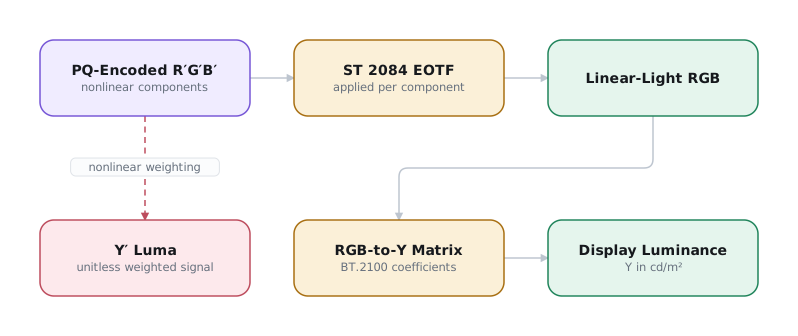
For BT.2100 primaries, the final linear-light calculation is:
YD = 0.2627RD + 0.6780GD + 0.0593BD
For a neutral signal, R′ = G′ = B′. The luma coefficients sum to one, so Y′ has the same normalized value as each RGB component. The decoded linear components are also equal. This special case makes luma and luminance appear interchangeable when discussing gray patches.
They are not interchangeable for saturated colors. Luma combines the nonlinear components before linearization. Luminance combines them after the EOTF. Because PQ is nonlinear, applying the EOTF to Y′ does not generally produce YD. A saturated red can therefore have one R′ signal value, a different Y′ luma value, and a physical luminance determined by the decoded red component and the red luminance coefficient.
Traditional SDR signal encodings are relative. Their nonlinear R′G′B′ values map to relative linear-light RGB, from which relative Y can be calculated. The signal alone does not assign a value in cd/m². Display calibration supplies the black and reference-white luminance. PQ instead maps its nonlinear signal to an absolute reference scale from 0 to 10,000 cd/m².14
The PQ signal describes the intended reference-display output. A physical display may produce less light because of its calibrated peak, color volume, power limits, or tone mapping. A specification such as 1,000-nit peak luminance describes measurable display capability, usually for a small highlight area. 1,000-nit peak luma is incorrect because Y′ is a unitless signal quantity. In industry shorthand, a “1,000-nit PQ value” normally means a PQ value whose decoded reference target is 1,000 cd/m², not a code value measured in nits.
How One HDR Master Reaches Other Displays
No consumer display exactly matches every mastering display. HDR workflows therefore combine image masters with measurements or mapping instructions.
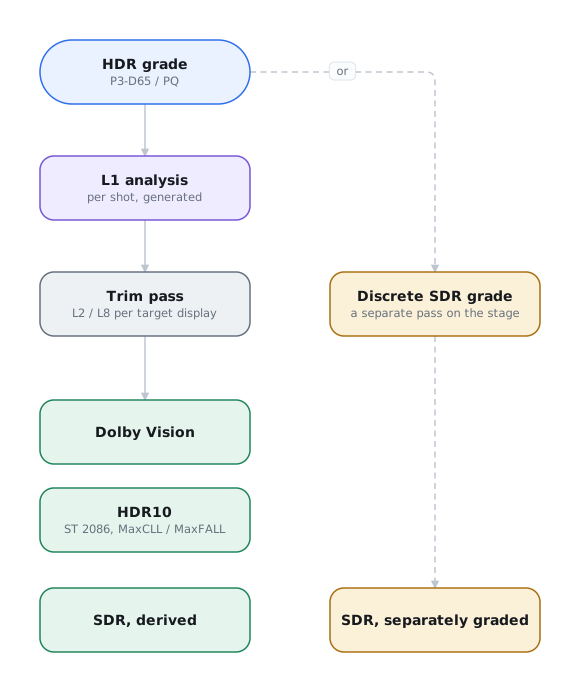
- Analysis measures the finished image. It can generate MaxCLL and MaxFALL values or Dolby Vision L1 metadata.
- A trim pass is a creative review of the HDR image mapped to another target, such as a lower-luminance HDR display or 100-nit SDR. The colorist adjusts trim controls when the automatic mapping does not preserve the intended result.
- A derived master is rendered from another approved master through an approved mapping. A Dolby Vision workflow can derive SDR from the HDR master and its trim metadata.
- A discrete grade is a separate creative grade for a specific target. It can share the same conform and creative intent, but the colorist adjusts the picture directly for that display.
Metadata
HDR signal values describe how the image should display. They do not describe how the image was mastered. Metadata records the reference conditions and, in dynamic systems, how to adapt the image for other displays.
| Standard or value | What it records | Kind |
|---|---|---|
| SMPTE ST 2086 | Mastering-display primaries, white point, and minimum and maximum luminance | Static |
| MaxCLL | Highest measured pixel luminance in the content | Static |
| MaxFALL | Highest measured average luminance of any frame | Static |
| SMPTE ST 2094 | Instructions that can change by scene or frame | Dynamic |
The mastering-display record identifies the calibrated target, not only a monitor model number. The DI records the display model, primaries, white point, minimum luminance, maximum luminance, and the calibration used for the session. Content-light values describe measured levels in the finished program. They do not describe how bright the image feels.
MaxCLL and MaxFALL come from analysis tools in mastering and QC systems, including DaVinci Resolve Studio and Colorfront Transkoder. Different tools can report different values because their analysis thresholds differ.3
Incorrect metadata does not change the reference master itself. It can cause a downstream encoder or display to choose an inappropriate tone map. Some systems ignore some metadata fields. Validate the metadata and inspect the encoded playback result.
Record and verify the HDR metadata
The DI records the mastering display and calibration, runs the required content analysis, and validates the metadata in the delivered file or sidecar.
Distribution Formats
| Format | Metadata | Licensing and use |
|---|---|---|
| HDR10 | Static ST 2086, MaxCLL, and MaxFALL | Baseline PQ delivery in a 10-bit BT.2020 container. Royalty-free. |
| HDR10+ | Dynamic ST 2094-40 | Open and royalty-free. Certification and logo use remain subject to the HDR10+ program terms.4 |
| Dolby Vision | Dynamic ST 2094-10 | Dolby does not charge a per-title creation or delivery fee. Full creative trim controls require a licensed tool, normally purchased by the DI or operator.5 |
Dolby Vision Analysis and Trims
Dolby Vision analysis happens after the HDR grade. The analysis generates L1 metadata for each shot. The colorist then reviews mapped targets and adds creative trims where the automatic result needs adjustment.6
Three metadata levels are most likely to require the colorist's attention:
- L1 records generated minimum, average, and maximum image measurements. It is the product of analysis and is not typically user-editable.
- L2 stores legacy CM v2.9 creative trims.
- L8 stores CM v4.0 creative trims with more controls.
Dolby recommends CM v4.0 for new projects. CM v4.0 contains backward-compatible CM v2.9 metadata, and a v2.9 deliverable can be exported from the v4.0 project. Legacy devices and UHD Blu-ray workflows remain common reasons to supply v2.9-compatible metadata. Obtain the requirement before mastering, then author in v4.0 unless the distributor specifies otherwise.7
A full review of the 100-nit Rec.709 mapping is Dolby's recommended practice and is often a buyer or studio requirement. Confirm whether the distributor expects a derived SDR master, a discrete SDR grade, or both.8
Budget the trim and mapped review
Budget Dolby Vision analysis, creative trims, and full mapped review as finishing work. They are not metadata export tasks.
Choose the HDR and SDR Finishing Path
Independent filmmakers are not bound to a studio's single-master policy unless a distributor has made it a delivery requirement. Choose the path that protects the film's primary audience and the available budget.
| Path | Benefits | Costs and limitations |
|---|---|---|
| HDR first, derive SDR | One approved picture master can drive HDR and SDR distribution. Revisions stay aligned. Studios and streamers can automate many downstream versions from one source. | HDR grading, Dolby Vision analysis, trims, and full mapped review must be budgeted before delivery. Image-global trim controls cannot replace every window, key, or spatial correction in a discrete SDR grade. |
| SDR first, add a discrete HDR grade | The production protects the most important indie deliverable first. HDR work can wait until a buyer commissions and specifies it. The colorist has direct creative control over each target. | A later HDR grade requires more stage time, a new render, and separate QC. Future picture changes must be reconciled across both masters. |
| Discrete HDR and SDR grades together | Both targets receive direct creative attention. This is useful when highlights, contrast, or color need substantially different treatment. | This costs the most finishing time and creates two approved masters that must remain synchronized. |
For many independent films, SDR first is the practical choice when no buyer requires HDR. If HDR is commissioned before finishing, HDR first can reduce later version management. A discrete SDR grade may still be the better creative choice when the SDR image cannot be reproduced with global trim controls.
Netflix publishes its HDR-first Dolby Vision guidance for Netflix Originals. Its branded-delivery guidance directs productions to the title's delivery-requirements list. An acquired title therefore follows its specific buyer instructions. Do not apply an Original mandate to an acquisition without confirmation.10
Set the finishing path before booking the grade
The producer asks whether the buyer requires HDR, which HDR format is required, and whether the SDR master must be derived or discretely graded. Follow your distributor's delivery schedule.
Mastering Decisions
The mastering display sets the color and luminance that the colorist can approve directly. A file may use a larger container than the display can reproduce. Grade within the display's measured color volume. Do not approve colors or luminance levels that exist only outside the calibrated display's capability.
Record the display's calibrated peak luminance, often 1,000 or 4,000 cd/m². Record its measured black level and gamut. Follow your distributor's delivery schedule for the file container and metadata.
BT.2020 Is a Container
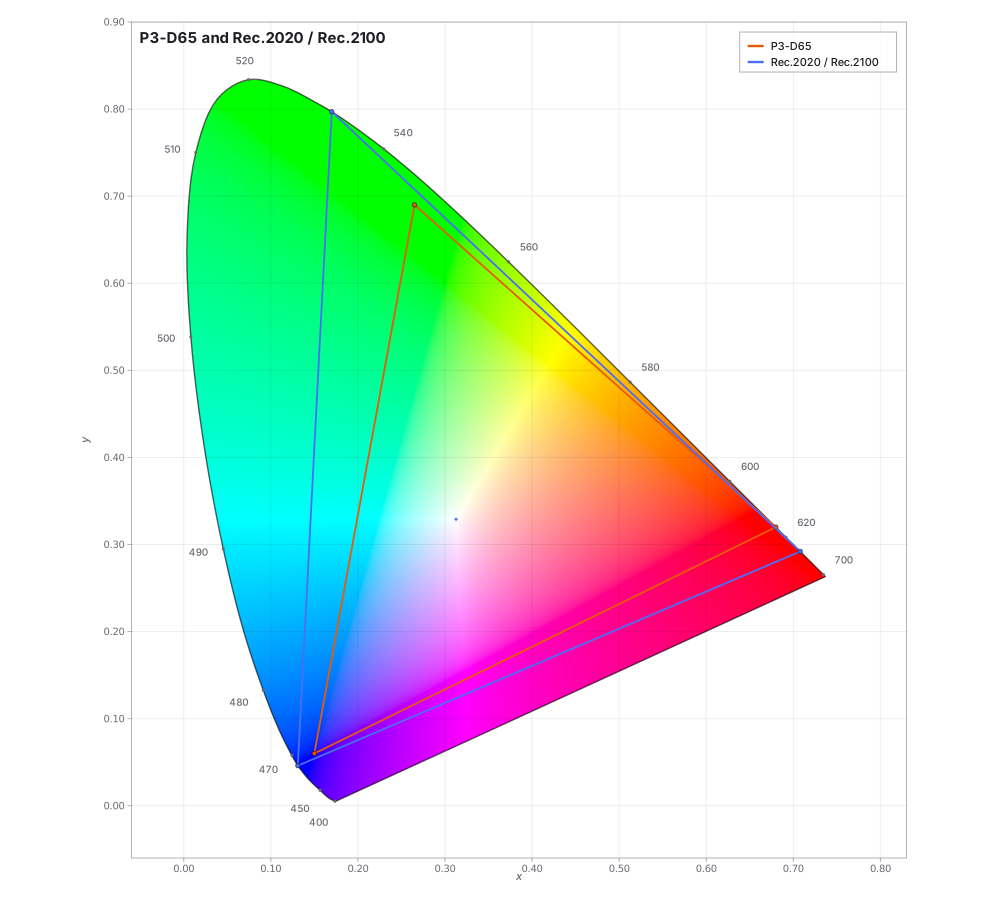
BT.2020 defines idealized red, green, and blue primary chromaticities at single wavelengths on the spectral locus.2 Most displays make each primary from an emitter with a wider spectrum. Their reproducible color triangle is therefore smaller than the full BT.2020 triangle.
As of 2026, few practical mastering or consumer displays fully reproduce BT.2020. P3-D65 remains a common mastering gamut because reference displays can reproduce it consistently. A master can be graded within P3-D65 and stored in either a P3-D65 or BT.2020 container, as the delivery specification requires.9
A typical HDR-first streaming deliverable set includes:
- an approved PQ HDR picture master in the required P3-D65 or BT.2020 container
- validated mastering-display and content-light metadata
- Dolby Vision metadata when required
- an approved SDR master derived through reviewed trims, or a discrete SDR grade when required
Theatrical HDR
Theatrical HDR is separate from the home HDR master. It uses specialty projection or emissive display technology. Dolby Cinema, CINITY, HDR by Barco, and direct-view LED systems require discrete grades, renders, and format-specific QC.11
- Dolby Cinema is a proprietary mastering and exhibition system. Installations have used different projection generations, so describing the format only as dual-projector or dual-laser is incomplete. Follow Dolby's supplied cinema target and delivery specification.
- CINITY combines high-luminance projection with its own presentation and mastering requirements.
- HDR by Barco uses Lightsteering projection to direct available light toward image highlights.
- Direct-view LED replaces projection with an emissive cinema screen. Each qualified system has its own mastering and delivery requirements.
Budget theatrical HDR separately
Budget a discrete grade, render, and QC pass for each theatrical HDR format.
Consequences for Visual Effects
HDR can reveal clipped highlights, hard CG rolloff, mismatched blacks, and edge artifacts that pass an SDR review. VFX needs the intended HDR path before plates and renders are specified.
Give VFX the HDR requirements before shot work
The image-pipeline lead and VFX supervisor specify:
- Bit depth. Use at least 12-bit log for HDR finishing. Prefer 16-bit floating-point for VFX interchange. See Camera Log.
- Highlight review. Check for clipped rolloff, clipped CG speculars, and black-point mismatches that an SDR review can hide.
- Target displays. Review the intended HDR displays or exhibition formats. Do not assume a Rec.709 review represents the HDR result.
- Exposure checks. Raise and lower exposure to compare artificial highlight clipping with the plate.
-
International Telecommunication Union, Recommendation ITU-R BT.2100-3, tables 2, 3, and 9, including note 3c. ↩
-
International Telecommunication Union, Recommendation ITU-R BT.2020, table 3. ↩
-
Dolby Laboratories, “Calculation of MaxFALL and MaxCLL Metadata”; Blackmagic Design, DaVinci Resolve 20 New Features Guide, “HDR and Dolby Vision Reports”; Colorfront, “Transkoder”, “Media Report.” ↩
-
HDR10+ Technologies, “Is HDR10+ an Open, Royalty-Free Standard?”. ↩
-
Dolby Laboratories, “Dolby Vision for Content Creators”, “Is Dolby Vision free to use?” ↩
-
Dolby Laboratories, “Dolby Vision Content Creation Best Practices Guide”, “Analysis” and “Trimming.” ↩
-
Dolby Laboratories, “Dolby Vision Versions: CM v2.9 vs. CM v4.0”, “Should I use CM v2.9 or CM v4.0?”; Dolby Vision UHD Blu-ray Authoring Workflow Guide, sec. 3. ↩
-
Dolby Laboratories, “Dolby Vision Content Creation Best Practices Guide”, “SDR Preview and Trim.” ↩
-
Dolby Laboratories, “How to Deliver Dolby Vision in Rec.2020”, “Recommended P3 to Rec.2020 Workflow.” ↩
-
Netflix, “Dolby Vision HDR Mastering Guidelines”, and “Post-Production Branded Delivery Specifications”. ↩
-
Dolby Laboratories, “Dolby Cinema”; Barco, “HDR by Barco”; CINITY, “CINITY”; Digital Cinema Initiatives, High Dynamic Range D-Cinema Addendum. ↩↩
-
Poynton and Funt, “Perceptual Uniformity in Digital Image Representation and Display”, pp. 6–7. ↩
-
International Telecommunication Union, Recommendation ITU-R BT.2100-3, tables 4–6; Society of Motion Picture and Television Engineers, SMPTE ST 2084:2014, secs. 3.5–4.3. ↩
-
Poynton and Funt, “Perceptual Uniformity in Digital Image Representation and Display”, pp. 6–8; Society of Motion Picture and Television Engineers, SMPTE ST 2084:2014, introduction and secs. 4.1–4.3; International Telecommunication Union, Recommendation ITU-R BT.2100-3, tables 3–4. ↩