IMF: The Interoperable Master Format
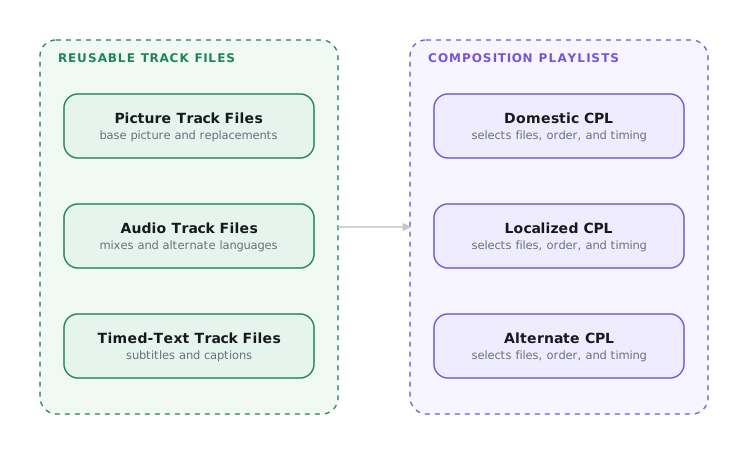
IMF is a component-based format used for mastering, preservation, streaming, and international distribution. Unlike a self-contained QuickTime, which combines picture and sound into one movie for one version, IMF keeps picture, audio, and timed text in separate reusable files. A playlist selects the files that make each version.
The problem IMF solves
Creating domestic, airline, language, music-rights, SDR, and HDR versions as separate movie files can duplicate nearly identical picture.
IMF stores picture, audio, and timed-text content as track files. Each Composition Playlist (CPL) selects the required files, frame ranges, order, and timing. An IMF update can add only replacement segments and a new playlist while reusing unchanged track files. IMF is a component-based mastering and versioning framework. It stores reusable resources and the instructions that assemble them into a presentation.
Structure
The package described by one Packing List is an IMP, or Interoperable Master Package. It includes that list and every asset the list inventories.4 People often call an IMP an "IMF package."
A delivery is the complete set of files transferred together. Its ASSETMAP tells the receiving system where each file is located. One delivery can contain one IMP or several related IMPs.
An IMP is a set of files with defined roles:
| Component | Role |
|---|---|
| Track Files | The picture, audio, and timed-text content, called essence, in separate MXF files |
| CPL (Composition Playlist) | Describes one composition: the track files, order, and timing |
| PKL (Packing List) | Inventory of the files in this delivery, with hashes for integrity |
| ASSETMAP | Maps asset identifiers to file paths on the delivered medium |
| OPL (Output Profile List) | Optional. Describes how to derive a specific output from a CPL |
| Sidecar assets | Optional files carried with the package that are not picture, audio, or timed text, such as scripts, QC reports, and artwork |
A Supplemental Package contains replacement segments and a new CPL while referencing unchanged track files from the original package. The new CPL can also select another language, subtitle configuration, frame range, sequence order, ending, or edition without duplicating every resource.
A CPL resembles an EDL. It identifies the picture, audio, and timed-text track files to play, plus their order and timing, instead of containing one continuous movie.
Validating a package
Photon is Netflix's open-source IMF validator. It checks the ASSETMAP, PKL, CPL, App #2E constraints, and MXF header metadata against the declared essence descriptors.
Photon does not decode pixels or verify PKL hashes. It may also warn rather than fail on unsupported namespaces. Use it for structural validation, then verify hashes and watch the picture separately.
DaVinci Resolve Studio can run Photon validation, but the option appears only when Java JDK or JRE 1.8 or later is installed. Photon is a separate Netflix project available on GitHub, not a validator included with Resolve by default.1 Run the full local validation before using Netflix's reduced delivery-interface check.
Application #2E
IMF applications constrain the framework to usable profiles. App #2E is common in studio and streaming workflows. It carries JPEG 2000 picture and uncompressed PCM audio in separate track files.5
The application number does not state whether the image uses lossless or lossy compression. A studio can use lossless App #2E as a top-level archival master and a lossy App #2E package as a distribution mezzanine. Disney calls these IMF-A and IMF-D. Those names describe Disney's mastering classes, not separate IMF applications or general industry terms.3
| App #2E use | Compression | Purpose |
|---|---|---|
| Lossless master | Losslessly compressed JPEG 2000 | Archival-quality source for downstream masters |
| Lossy mezzanine | Lossy JPEG 2000 at a constrained bit rate | Distribution and servicing |
JPEG 2000 is intra-frame and frame-addressable, so a composition can change at any frame without temporal dependencies. App #2E also permits HTJ2K (high-throughput JPEG 2000), which encodes and decodes faster than the original block coder at the same quality.5 Standardization does not guarantee recipient support. Disney, for example, currently requires express approval for HTJ2K masters.3 This use of HTJ2K describes JPEG 2000 picture essence in IMF track files. It is separate from the HTJ2K compression options in OpenEXR.
Other IMF applications support specific archival, ACES, and ProRes workflows. Some studios use them, but their existence does not make them general delivery requirements. An independent filmmaker usually needs an IMF only after a distributor or archive requests one. Do not select an application from a standards list. Give the mastering facility the distributor's current specification.
Netflix is one example of a distributor that requests App #2E. Its current delivery specification controls the package profile and audio configuration.2
Production requirements
A mastering facility or specialist vendor normally authors the IMF. The producer provides the distributors' specifications. Editorial, the DI, sound, and accessibility vendors supply these materials:
Prepare the IMF during post-production
- Producer: Provide the distributors' specifications. Obtain the complete distributor specification before the DI is completed. “IMF” alone is insufficient. Note the application, audio configuration, HDR variant, and expected supplemental packages.
- Editorial and DI: Supply full-shot textless elements for every title, caption, and dub card that can vary by territory. Distribution textless elements normally match the cut frame for frame. Do not include out-of-cut handles unless the distributor requests them.
- Post-production supervisor: Organize known alternate cuts and elements during the DI. Adding them later means reopening the master.
- Mastering facility: Enforce naming and versioning. Validate that each supplemental CPL references the intended segment versions.
-
Blackmagic Design, DaVinci Resolve 21 Reference Manual, “Photon Validation of IMF Packages,” p. 4227. Netflix, Photon IMF Validator. ↩
-
Netflix, “Interoperable Master Format (IMF): Overview” and “Post Production Branded Delivery Specifications.” Confirm the current versions before delivery. ↩
-
Walt Disney Studios, “IMF Master Packages,” “Master UHD HDR BT.2100 PQ IMF Package” and “Master UHD IMF-HT Package,” and “IMF Distribution Packages,” “Distribution UHD HDR BT.2100 PQ IMF Package.” ↩↩
-
SMPTE, ST 2067-2:2020, Interoperable Master Format: Core Constraints, sec. 7.2. ↩
-
SMPTE, ST 2067-21:2023, Interoperable Master Format: Application #2E, secs. 5–7 and annex I. ↩↩